



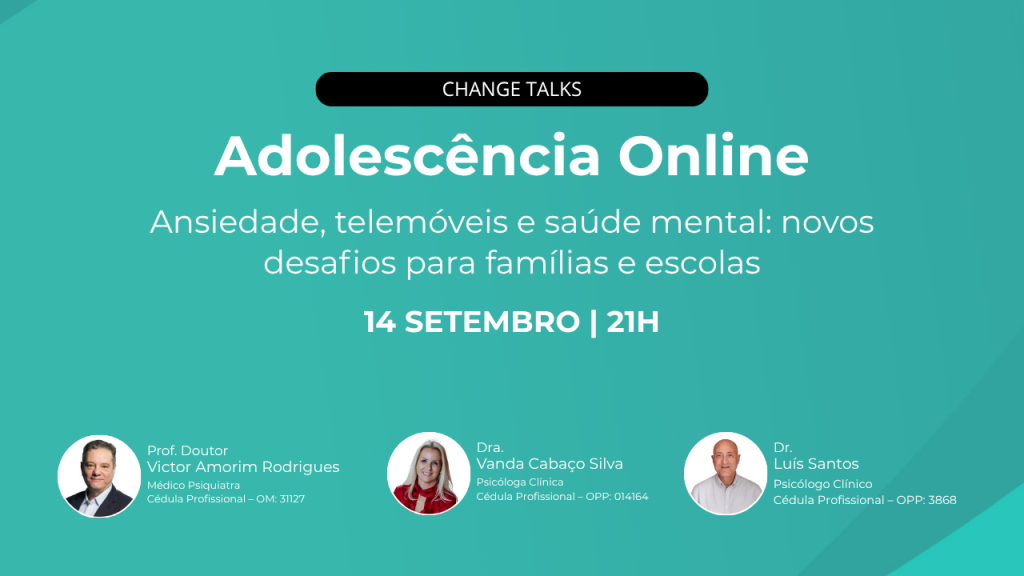
In the upcoming Change Talks webinar, scheduled for September 14 at 9:00 p.m., the topic is adolescence in the digital age and the challenges the online world poses to young people’s mental health. This discussion comes right in the middle of back-to-school season, at a time when the debate over cell phones, social media, and teen anxiety has never been more urgent.
Free to attend, this fifth Change Talks webinar promises to be an accessible, in-depth, and candid discussion about an issue that is increasingly affecting young people, families, and schools—and for which clear answers are still lacking.
SIGN UP HERE TO WATCH THE NEXT WEBINAR
The numbers we can't ignore
In Portugal, nearly 31% of young people exhibit symptoms of depression, most of which are moderate or severe. An OECD report published in 2026 concludes that the mental health of children, adolescents, and young adults has consistently worsened in most countries over the past decade and that this trend was already evident before the pandemic. In all the countries analyzed, girls and young women are the most affected, and the disparity compared to boys has been increasing.
In Portugal, the government responded to this situation with concrete measures: starting with the 2025–2026 school year, the use of smartphones has been banned in schools through the 6th grade. The results are already visible, with a decrease in bullying and misbehavior and an increase in social interaction. The ban will be extended to middle school starting in January 2027. But banning smartphones in school does not solve the problem outside of school. The central question remains: how can we help teenagers—and the families and schools that support them—develop a healthy relationship with the digital world?
When does cell phone use become a mental health issue?
This is one of the central issues of the session. Excessive and compulsive use of cell phones and social media is linked to increased anxiety, social isolation, and depressive symptoms in adolescents. The point is not to demonize technology, but to understand where the limits lie and how to recognize when they have been crossed.
Ease of access, algorithms designed to maximize screen time, and the social pressure of social media create a particularly demanding environment for developing brains. For the most vulnerable teenagers, the cell phone can become a numbing distraction—an escape that temporarily relieves anxiety but fuels it in the long run.
What topics will be covered in the webinar on adolescence, anxiety, and mental health?
Throughout the session, members of the clinical team at The Clinic of Change will answer questions such as:
- How is excessive use of cell phones and social media affecting the mental health of teenagers?
- When does online behavior become a clinical problem?
- What are the main warning signs that families and schools should be aware of?
- How can parents and educators help without fueling the conflict?
- What treatment options are available?
Who are the speakers?
The discussion features three experts from the clinical team at The Clinic of Change. Victor Amorim Rodrigues, a psychiatrist, professor at ISPA, and clinical director of The Clinic of Change, has dedicated his career to clinical, forensic, and addiction psychiatry, with training in ketamine-assisted psychotherapy from Awakn Life Sciences (now Solvonis Therapeutics).
With over 20 years of experience, Vanda Cabaço Silva is a clinical psychologist who specializes in psychological counseling, psychotherapy, and psychological assessment. She works with children, adolescents, and adults, and has specialized experience supporting expatriate families and working in multicultural contexts.
A specialist in Clinical and Health Psychology, Luís Santos favors a humanistic approach centered on the therapeutic relationship, working with adolescents and adults. He has experience in depression, the grieving process, gender identity, and LGBTQIA+ issues, as well as in Community Psychology and providing expert testimony to the courts on matters related to children and youth.
When gambling stops being a pastime and becomes an addiction
In a conversation, we brought together two realities that are increasingly present in our daily lives: video games and gambling. Learn more about the topic— watch (or rewatch) the latest Change Talks webinar.