

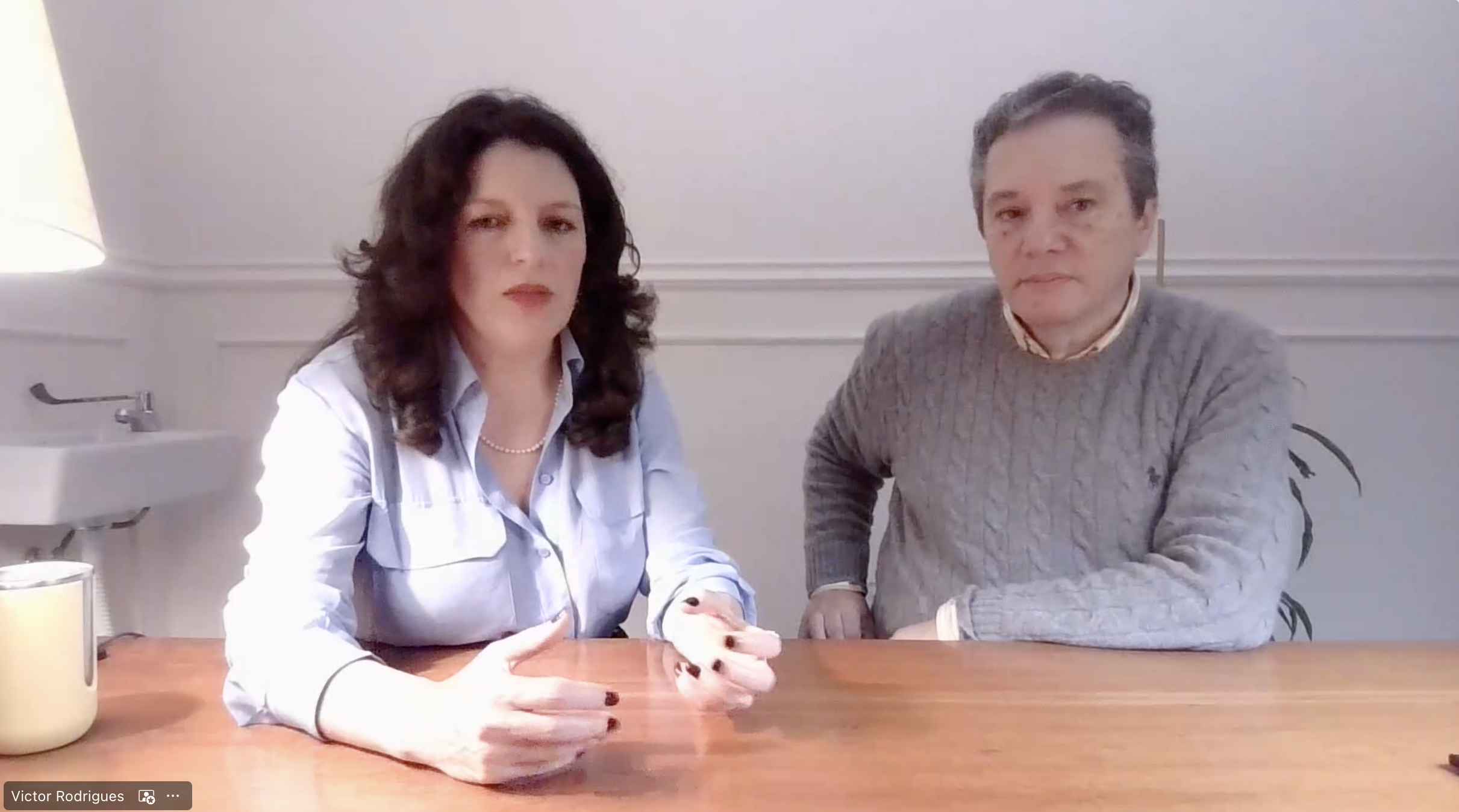

On February 10, the first Change Talks webinar took place. Free to attend, it proved to be an accessible, clear, and thoughtful discussion centered on two major challenges we face today as a society: treatment-resistant depression and alcohol dependence.
Without ever losing sight of The Clinic of Change’s primary mission—to care for and preserve mental health—the conversation addressed such pertinent topics as the symptoms of both conditions, the hope offered by scientific advances in the field of psychedelics, the importance of psychotherapy in conjunction with this type of treatment, and the importance of professional and specialized care.
The discussion therefore featured two speakers, both members of the clinical team at The Clinic of Change: Prof. Victor Amorim Rodrigues, M.D., Clinical Director, psychiatrist, and psychotherapist, and Dr. Carla Mariz, clinical psychologist, psychotherapist, and neuropsychologist.
What are psychedelics?
This question comes up frequently in the day-to-day operations of The Clinic of Change, and in this first webinar, it kicked off the discussion among the panel members.
“These are substances we call psychotropic, meaning they affect the central nervous system and the mind. They induce altered states of consciousness that involve emotion, perception, and thought. They have been used for millennia for ritual purposes and, more recently, for recreational purposes. However, it has been recognized since the 1960s—and especially now in this century—that they have therapeutic effects and can be used very effectively from a therapeutic standpoint, particularly in psychiatric settings , ” began Prof. Victor Amorim Rodrigues.
What impact does treatment-resistant depression have on people's lives?
It is one of the mental health conditions that most affects the Portuguese population, but it is also one of the situations in which psychedelic-assisted therapy has helped improve the daily lives of many people. With the help of both experts, we have compiled a list of common symptoms experienced by those suffering from treatment-resistant depression.
“These are people who have been profoundly affected emotionally. They’ve become isolated. They’ve lost the ability to work,
to form relationships, to sleep well, and to find joy in life’s simplest pleasures. Treatment-resistant depression has a truly devastating impact on these people’s lives, ” summarizes Dr. Carla Mariz.
“Many people simply cannot work. Others work, but they’re just going through the motions, so to speak. And they experience a total lack of pleasure in their lives—what is technically called anhedonia, which is the absence of pleasure, and it’s a terrible thing. From the moment they wake up until they go to bed, they’re always thinking: when will this end? My life is a torment. There are small activities that give us pleasure—for these people, that doesn’t exist,” adds Amorim Rodrigues.
How important is psychotherapy throughout the course of treatment?
At The Clinic of Change, the treatment protocol involves the administration of ketamine, a psychedelic that enhances the brain’s neuroplasticity, combined with follow-up psychotherapy sessions.
“I would say that psychotherapy is the most important part, which is why it’s ketamine-assisted psychotherapy and not the other way around. It’s not simply a ketamine treatment that relies solely on its antidepressant effects—which are, in fact, very potent—or on its neuroplasticity effects. But then, without helping to consolidate new ways of functioning, of thinking, of feeling, of seeing things… And that is the role of psychotherapy. This integration is fundamental. One thing without the other is, if you will, a bit lacking,” continues the Clinical Director.
How long does it take for a person to start feeling better?
The webinar was also open to questions from the audience. Among them was a question about how long it typically takes for a patient with treatment-resistant depression to begin seeing results.
“It varies. We have people who feel great right away during their first session, but who still think it might be temporary. But it isn’t. Then there are people who only start feeling better toward the end. They’re called ‘late responders .’ So, it varies. Every case is different, ” explains Dr. Carla Mariz.
How can the same treatment be applied to cases of alcohol dependence?
During the conversation, the two experts discussed alcohol dependence, another problem that can be treated using ketamine-assisted psychotherapy. “We are, in fact, addressing the issue of cravings, which significantly reduces that intense desire to drink. And it allows us to work on relapse prevention. We’re talking about trying to extend the period of abstinence as much as possible, so that people don’t relapse. Here, ketamine will open up possibilities. But, once again, the key component is psychotherapy,” explains Prof. Victor Amorim Rodrigues, Ph.D.
And what is the success rate of this treatment when applied to cases of alcohol dependence?
The numbers speak for themselves. “We do, in fact, have very encouraging figures. If we consider standard treatments—
—
after one year, we see relapse rates of around 75%. So only 25% of people remain abstinent. And here, our rates are well over 50%, ”concludes Amorim Rodrigues.
This was the first edition of Change Talks, an accessible, responsible, and informed discussion on mental health. We will announce the next edition and the topics to be covered shortly. Until then, watch or rewatch the webinar HERE.
Learn more about our psychedelic-assisted programs and treatments HERE.